

News & Updates
The information war of the West – an analysis of the tools applied in Yugoslavia and Ukraine

By Alexander K. Kamkin
Financial University at the Government of Russian Federation
Currently, the case of Russia’s aggression against Europe is a common place in almost all mainstream media in Europe. The largest European media scare European citizens with Russian tanks on the streets of German, French, and Belgian cities. Military experts in Western countries complain about the insufficient training and financing of the armed forces for the inevitable war with Russia from their point of view[1]. In addition to Russia’s alleged war crimes (the authors of the information materials do not provide any evidence), one of the favorite topics in recent months has been the topic of Russian drones in the skies of European cities. The situation sometimes reaches the point of absurdity when the airports of Berlin, Munich, and Brussels are closed for several hours. At the same time, the French Navy conducted an essentially pirated seizure of a tanker with Russian oil in neutral waters flying the flag of an African country. The pretext was the alleged launch of Russian reconnaissance drones from aboard this vessel.
Combined with aggressive militaristic rhetoric and changes in the legislation of some EU countries, it seems that Western countries are pursuing a well-coordinated information war against Russia. It should be noted that this information war did not begin at all in 2022 (although its scope has become much wider since its beginning), but much earlier. Ten years ago, the book “Corrupt Journalists” by the famous German journalist Udo Ulfkotte made a lot of noise in many countries, including Russia [Ulfkotte 2015]. In his book, he mentioned more than 200 reporters from the largest German and multinational media outlets, exposed their networks with financial circles, special services, and high-ranking officials. In his study the journalist came to the unequivocal conclusion that the Western mainstream media are extremely biased in covering important topics such as the Middle East and the Balkans and are a tool for promoting “pseudo-justice” beneficial to certain circles in the political class of the United States and Europe. This information war strategy is particularly pronounced during large-scale crises and military conflicts. Currently, during the war in Ukraine, Western media use fakes and double standards in their coverage of events in the same way as in the cases reviewed in detail by Udo Ulfkotte. It should be noted that the Western media were very actively and biased in the aggression (first informational) against SR Yugoslavia in the period from 1990 to 1999. This article compares these two cases, since the tools of information warfare were particularly noticeable in the “demonization” of Serbia in the Western media during the civil war in the former Yugoslavia and the NATO intervention in the Balkans, as well as to an even greater extent in the media coverage of the collective West of events in Ukraine, starting at least since 2014.
It was the war in the former Yugoslavia and the biased attitude of the EU and the United States towards its participants that became one of the first examples of complex information war and at the same time completely repeated the policy of the European powers towards the Slavic peoples of the Balkans in the 19th century, as F.M. Dostoevsky wrote in his “Writer’s Diary”.
As a result of internal contradictions, socialist Yugoslavia found itself in a difficult situation by the end of the 1980s. After Tito’s death, allied leaders of Slovene and Croatian descent actively worked for the collapse of the country. Since the mid-1980s, Albanian separatism has been spreading in Kosovo, high-profile cases of acts of terror against the Serbian minority were very painfully perceived by the Serbian public, which eventually forced S. Milosevic to revoke the autonomy of Kosovo in 1989, in celebration of the 500th anniversary of the Battle of Kosovo. An interesting fact is that many Western European states, the United States, and even the Vatican have sided with those seeking secession from Slovenia and Croatia. For example, in January 1991, the new Croatian authorities received a loan of four billion US dollars from Vatican. With reference to the newspaper “Leipziger Volkszeitung”, the German opposition magazine “Ketzerbriefe” wrote about it the following:
“The Vatican has provided Croatia, the second largest Yugoslav republic, with an almost interest-free loan of four billion dollars…Croatia will use this money to buy not only consumer goods, but also weapons” [Vatikan gibt Kroatien… 1992: 3].
In early 1992, the armed conflict in Bosnia and Herzegovina began. It was provoked by radical Muslim Bosniaks who elected their president, Ilia Izetbegovic. From the very beginning, he set a course for the Shariaization of Bosnia, and emissaries from Turkey and the Persian Gulf countries came to the republic. The radical attack on the Serbian wedding procession in Sarajevo became a kind of trigger for the conflict.
However, it is wrong to view the war in Bosnia as a conflict between Muslims and Christians. The Western media never mentioned, for example, the fact that up to 5,000 Bosnian warlord Fikret Abdic’s formations were fighting on the side of the Bosnian Serb army. Abdic held secular views and did not want Bosnia to be radicalized by external forces.
At the same time, the separatists in Croatia and Bosnia received financial and armed support from abroad. A clear evidence of that facts was obtained in the fall of 1991 during the storming of the administrative center of Eastern Slavonia, Vukovar, by units of the JNA and Serbian self-defense units. Along with the fighters from the HDZ[2], the city was defended by more than 500 mercenaries from Germany and Austria (the Condor brigade), as well as about 150 Americans from the Chicago group [Vilic, Todorovic 1995: 12].
During all that time, an information campaign regarding the events in the Balkans was conducted in almost all Western media, as well as in parliaments. The presumption of guilt was applied to the Republika Srpska and the Serbian Krajina, especially during the fighting near the Muslim enclaves of Gorazde and Srebrenica in early 1995. Virtually the entire Bosnian Serb military and political leadership has been declared war criminals, starting with President Radovan Karadzic and General Ratko Mladic.
From the very beginning of its existence, the Croatian regime of Franjo Tudjman pursued a course of continuity with the pro-Nazi state of Ante Pavelic, a Nazi collaborator. It should be recalled that it was Ante Pavelic who killed King Alexander I of Yugoslavia in Marseille in 1934, and after the occupation of France by Nazi Germany, he was released from penal servitude and appointed as head of the Independent State of Croatia. His associate, the head of the security service, Andrija Artukovic[3], who was secretly called the Balkan Himmler, surpassed even his German teachers in his cruelty. Thus, the independent Croatia of the 1990s had a corresponding inheritance.
From the very beginning of the war, Western media and politicians unequivocally sided with the separatists, covering up their crimes and demonizing the Serbian side. Economic sanctions have been repeatedly imposed against the Federal Republic of Yugoslavia, as a result of which it has been completely excluded from the world community, like Iran and North Korea. At the same time, the Western media conducted a systematic diffammation campaign and carried out a kind of “conspiracy of silence” regarding the situation of Serbian civil population. Here are some examples of such insinuations in the Western media.
In the August 7, 1992 issue of the English magazine Daily Mirror, a photograph was published that became a symbol of the Bosnian war – a group of men behind barbed wire with the inscription “Must it go on?”). The photo was accompanied by an explanation, from which it was clear that these were Bosnian Muslim prisoners in the Serbian “concentration camp” of Trnopolje. However, in February 1997, German journalist Thomas Deichmann published an expose of this propaganda fake. In fact, there was an ordinary collage. There was no barbed wire around the camp in Trnopolje, it was not even a camp, but just a gathering point for refugees. The barbed wire in the photo was not surrounding the camp, but the photographer and the journalists. There was a guarded facility near Trnopolje, surrounded by wire fences. As the researcher wrote, “British reporters filmed the wire from the side of the buildings against the background of an open field, then overlaid the negative with the wire on the negative with people, and the result was a photograph that gives the impression that these Bosnians are really behind barbed wire” [Polikarpov 2018].
Such fakes with collages (AI had not yet been invented) were used massively. In particular, during the NATO intervention in Kosovo in March 1999, The Moscow Times, an English-language newspaper in Moscow, published a photo with several tanks on the front page, explaining that the photo showed Serbian units not intending to leave Kosovo despite the NATO ultimatum. The photo was chosen in such a way as to evoke negative emotions towards the Yugoslav army in readers – the guns and the stern faces of the tankers were clearly visible in the photo. But at the same time, the Albanian flag was flying over the tank in the foreground.
Another example of fakes about “Serbian atrocities” is the Western media’s interpretation of the explosion at the Mercale market in Sarajevo on August 28, 1995, which killed 36 people and injured 86 others. Even UN representatives said that “it is unclear which side fired this mine from a 120-millimeter mortar” [Wie Hitler den Krieg 1995: 19]. However, the Western media blamed the Serbian side for the complete lack of evidence of this fact. The opposition magazine Ketzerbriefe wrote about the double standards of the West in this regard: “Did you know that the explosion of a 120 mm shell is not able to kill 60 people and injure three times as many, that the Mercale market, where this tragedy occurred on February 5, is too far from the Serbian positions for such an accurate shot? And why do Muslims refuse to allow a neutral international commission to investigate? There can be no valid reasons for this refusal except one – it was the work of the Muslims themselves” [Wie Hitler den Krieg 1995: 20].
Similar technologies of double standards in the information war were used by the West during the events in Kosovo in 1998-1999.
The first clashes between the Serbian and Albanian populations of Kosovo began back in the 1980s. The active resettlement of Albanians from neighboring Albania has been going on almost since the 1950s, with an open-door policy on the part of the Yugoslav authorities. Since the early 1990s Kosovo and Metohija were the scene of rampant Albanian extremism. Civilians, government officials, and police officers were systematically attacked. Moreover, the guerilla ar of Albanians sharply intensified with the outbreak of the conflict in Bosnia. Even one of the 1999 issues of Spectator magazine spoke about the atrocities of illegal migrants from Albania and Kosovo in Italy: “Millions of Italians learn every day from newspapers about the activities of the Albanian mafia … first there is information on the television news about the atrocities of the Serbs and NATO airstrikes to save Kosovo, and then local news about attacks by gangs of Kosovo Albanians on Italian pensioners” [Unexpected conclusions 1999: 3]. The catalyst for the activity of the Kosovo separatists was the people’s revolution in Albania in 1998, when the country’s population overthrew President Sale Berisha. At the same time, many army depots were looted, and most of these stocks migrated to the arsenals of the so-called “Kosovo Liberation Army” (UCK).
As the first stage of the information war, reports of alleged crimes by the Serbian army and police against the Albanian civilian population began to spread in the Western press.
Thus, by the beginning of 1999, world public opinion was prepared to accept NATO aggression. The only thing left was the pretext, which served as another propaganda fake in the spirit of the Sarajevo bombings – the staging of events in the village of Racak in January 1999.
On January 15, 1999, an armed attack by Albanian militants on a Yugoslav police patrol was carried out. Additional police forces arrived at the scene of the attack and were met with heavy fire. The police had to respond to this attack. The next day, the head of the OSCE observation mission in Kosovo, William Walker (a retired CIA officer), called a press conference, where he declared to the whole world that what had happened was evidence of genocide carried out by the Yugoslav government against Albanian civilians. Regarding such a shameless lie, the President of the Republic of Serbia, Milan Milutinovic, made a statement in which, in particular, he said:
“All the time he was in our counry, he (William Walker – Auth.) did not notice only the crimes of terrorists… He … remains indifferent to the atrocities of terrorists, which can only be explained by the fact that he protects them” [Milutinovic 1999:5].
The ideologists of NATO considered the “humanitarian catastrophe” that had taken place in Kosovo as a result of ethnic cleansing to be the main justification for their actions. But since the start of the NATO strikes, it has become clear that they are primarily aimed at undermining the military, economic and information security of Yugoslavia. Ancient monasteries in Gracanica, in Pec (Serbian Patriarchate), etc. were attacked. By the way, hundreds of Albanian civilians were also killed by NATO bombs in Kosovo. It is enough to recall the shooting of a column of Albanian refugees by NATO planes that mistook carts and tractors for tanks. 87 people died and 70 were injured [Ранђеловић 1999: 86].
After the occupation by the NATO troops, acts of violence by Albanian terrorists against non–Albanian residents became a real genocide. Here is some evidence of this: “In the town of Istok in northwestern Kosovo, where 1,200 peacekeepers from the Spanish KFOR contingent are stationed, KLA militants brutally killed four more Serbs. On the eve of the massacre, the Serbs vainly asked for help from the Spanish military… One of the commanders of the Spanish peacekeepers dared to express a seditious thought: “The KLA acts this way because it knows that if not a single Serb remains here, then the independence of Kosovo will become inevitable” [Peacekeepers in Kosovo 1999: 2].
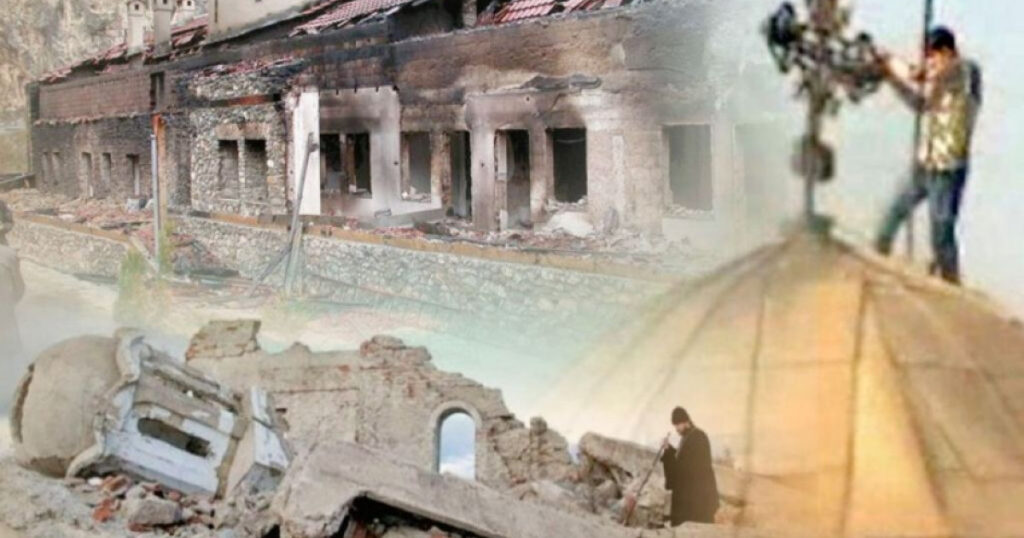
Recent events in Kosovo in 2021-2025, including the provocation with a monastery in northern Kosovo, confirm the Western media’s biased attitude towards the situation in the region.
According to the same scenario, the strategy of double standards of Western media and politicians was carried out in relation to Ukraine. The artificial division of society there required a long period, so the hot phase of the conflict broke out when a new Ukrainian identity was already established, based on rabid Russophobia and the opposition of Ukraine to Russia and the Russian world. The Kiev Maidan of 2013-2014 became a kind of point of no return in the artificial separation of Malorossija and Russia. The ideologists of Ukrainization, in turn, called this process the formation of a Ukrainian civil nation.
If in 1991 a state border was drawn between Russians and Ukrainians, however, it was quite transparent, then over the following years the propaganda of official Kiev diligently created a separate Ukrainian nation, which should not be in any way similar to the Great Russians. Former President of Ukraine Leonid Kuchma, at one of the events dedicated to Taras Shevchenko, said the remarkable phrase “We created Ukraine, now it remains to create Ukrainians.” This is a very eloquent statement, which testifies to the artificial division of actually one nation into two not only supposedly different, but also antagonistically disposed towards each other.
The collapse of the USSR in 1991 was not just the collapse of the socialist economic system. In fact, Russia was destroyed within the borders of the historical empire, with the exception of some territories. Historically, Russia has been more than just a mechanical accumulation of geographical regions and peoples. So, the Russian philosopher I.A. Ilyin wrote in his truly visionary work “What the dismemberment of Russia promises the world” (collection of articles “Our Tasks”): “Russia is not a random accumulation of territories and tribes and not an artificially coordinated “mechanism” of “regions”, but a living, historically grown and culturally justified organism that is not subject to arbitrary dismemberment. This organism is a geographical unit… This organism is a spiritual, linguistic and cultural unity that historically connected the Russian people with their nationally younger brothers through spiritual mutual understanding. It is a state and strategic unity that has proved to the world its will and its ability to defend itself; it is a veritable bulwark of European-Asian, and therefore universal peace and balance.” [Ilyin 1956: 245].
This quote contains not only an understanding of the very “Russian world” that Russian politicians have been talking about so much in recent years, but also, in a certain sense, a messianic understanding of Russia, as F.M. Dostoevsky and N.Y. Danilevsky saw it.
How did the independent Kiev authorities create Ukrainians? In 1959, the President of the United States, D. Eisenhower signed a document that defined the relationship of the collective West with the USSR (geopolitically Russia) for decades. It was called the “Law on Enslaved Nations” (PL 8690) [Nazarov 2014]. It served as the backbone of not only the anti-Soviet, but also the anti-Russian policy of the West (the law has not been abolished till now). His main idea is that the USSR was essentially a “prison of nations”, where the Great Russians were the jailers as the main bearers of Bolshevism. The authors of the law set the task of the West to liberate the peoples of the USSR enslaved by the Great Russians and grant them independence. In fact, the law prescribed the dismemberment of the USSR into a couple dozen nominally independent but Western-oriented territories. It was the same concept that was spelled out in Hitler’s famous Ost plan, adopted shortly before the launch of the Barbarossa plan. It also prescribed dividing the USSR into governorships, vassal territories, etc. The outlying peoples of the Soviet Union had certain advantages over the Great Russians. It was in this vein that the policy of the Nazi occupation authorities was pursued during the occupation years. Numerous punitive military units were formed from among the outlying peoples and independents, in particular the SS Galicia Division and several Baltic Waffen SS divisions. After the war, many fighters managed to escape justice and settled in Canada, the United States, and Western Europe, forming the backbone of anti-Soviet and Russophobic structures that were mobilized by the “Law on Enslaved Nations.”
An example of such structures is the “Anti-Bolshevik Bloc of Peoples (ABBP)”, formed by the Anglo-Americans in Munich shortly after the famous Fulton speech by W. Churchill. It included various anti-communist organizations from a number of European and Asian states. It is noteworthy that Yaroslav Stetsko, an associate and right-hand man of Stepan Bandera, the head of the Nazi collaborators in Ukraine, became the first president of the ABBP. At the same time, he headed this structure for almost 40 years until his death in 1986 [Nazarov 2014]. Moreover, after Ukraine declared independence in 1991, Stetsko’s widow, Yaroslava Stetsko, was honored in Kiev at the celebration of the 50th anniversary of the “Act of Proclaiming the Restoration of Independence of Ukraine” (after the German occupation in the summer of 1941 – Auth.). In 1998, Stetsko was even elected to the Verkhovna Rada [Nazarov 2014].
Ya. Stetsko is no an exception. The American footprint in the political elite of independent Ukraine is very diverse. In 1949, another Ukrainian nationalist Lev Dobryansky became president of the Committee of the Ukrainian Congress of America (CUCA), which was founded in Washington on May 24, 1940 in order to fight “for the independence of the Ukrainian nation.”
For example, Paula Dobryansky, the daughter of militant Russophobe Lev Dobryansky, was the leading adviser to US Secretary of State Condoleezza Rice and was working on issues of the post-Soviet space. She made her career from an employee to director of the USSR and Eastern Europe Department of the National Security Council in the White House. Another example is the wife of the former President of Ukraine Viktor Yushchenko, Ekaterina Chumachenko, who headed the National Information Bureau of Ukraine, which was established in 1976 in the United States [Nazarov 2014].
After the defeat of Nazi Germany in 1945, members of the OUN (Organization of Ukrainian nationalists) and their UPA paramilitary units joined foreign propaganda agencies and intelligence services to fight against the USSR during the Cold War.
In 1956, the CIA combined a number of networks and created the non-profit research and publishing association “Prologue”, which aimed to publish anti-communist propaganda, including radio broadcasts, newspapers, and books. During the Cold War, the Ukrainian diaspora and veterans of the OUN-UPA actively whitewashed the organization’s crimes. They created historical falsifications and myths about the OUN and UPA as peaceful organizations that saved Jews during the Holocaust and fought simultaneously against Hitler and Stalin. After the collapse of the USSR, these narratives began to fill the ideological gap in the new Ukrainian state [Why is…2022].
The apotheosis of this process was the honoring of Mr. Gunka, a veteran of the Waffen-SS Galicina division, in the Parliament of Canada in 2023.
The ideological heirs of Bandera largely determined the domestic and foreign policy of Ukraine and were the main ideologists of the next Maidan in the winter of 2013-2014. It was this event that served as a watershed point in relations between Russia and Ukraine, when Western politicians, providing media, information and diplomatic support to the Kiev junta, brought relations between the two peoples to a full-fledged war between them. In addition, activists of radical Ukrainian organizations conducted active subversive work on the territory of Russia itself, recruiting activists, preparing the Nazi underground for terrorist attacks, etc. [In Russia, 2021 was revealed]. I.A. Ilyin’s gloomy prophecies about the consequences of the dismemberment of Russia came true, when the thinker wrote about the inevitable emergence of zones of armed conflict along fault lines between parts of a single integral state. Further events went completely according to the Yugoslav scenario. The population of eastern Ukraine and Crimea, unwilling to accept the ideology and way of life of the new Ukraine, chose to link their fate with the Russian state, just as the population of Serbian Krajina and Slavonia did not want to live in a single state with the ideological heirs of the Nazis, the Ustasha of Ante Pavelic. The analogy with the events in Ukraine and Yugoslavia and the dangers of the Balkan scenario in the event of further disintegration of the Russian state was recently recognized by Russian President Vladimir Putin in one of his interviews [Putin suggested 2021]. This is especially relevant in the light of the hatched plans of some notorious Russian opposition leader seeking support in the West to further dismember the Russian state, which was announced in November 2021 by one of the sponsors of the non-systemic opposition in Russia, M. Khodorkovsky, who pointed out the possible departure from Russia of a number of regions of the North Caucasus, the Volga region, etc. [Pearl 2021]. If these plans would be implemented, bloody conflicts along the fault lines of the united state were more than likely.
The reaction of the collective West was quite predictable. Russia, like Yugoslavia, was bombarded with accusations of supporting the separatists, just as in the case of Belgrade, a spiral of sanctions war was unleashed. Just like in Sarajevo, Damascus, and Kosovo, provocations were carried out in order to shape public opinion in the right direction. So, the story of the Boeing MH17 shot down over Donetsk was immediately used by the Western media and the political community to accuse Russia of participating in the conflict in Donbass. However, the end of this case has not yet been reached.
An important moment in the Nazification and separation of Ukraine from Russia is the struggle against Orthodoxy in the territories controlled by Kiev, which began in the early 1990s by schismatics and received a powerful impetus due to the destructive actions of Patriarch Filaret of Constantinople, who actually initiated and institutionalized the split of Orthodoxy in Ukraine. The seizure of churches and the arrests of clergymen actually continued the actions aimed at the Ukrainization of the population.
The events of the last four years, when a Special military operation began, should be highlighted. The reaction of the West, the supply of various weapons, financial assistance worth many billions of USD (the EU alone financed Ukraine from February 2022 to October 2025 for more than 180 billion euros), information support for the Zelensky regime – all this recalls the events in Yugoslavia in the 1990s and speaks to the correctness of the thesis of the Russian Slavophile N.Ya. Danilevsky on the hostility of Europe (i.e. the collective West) towards Russia.
As for the Western media, from the very beginning of the Russian Spring, they provided information to the Kiev regime, glorifying the Nazi battalions Azov, Aidar[4], etc., spreading fake news about the Russian army. In addition, foreign agents who have escaped from Russia are actively involved in the propaganda machine of the West, some of them work in the Russian-language editorial offices of German, British and other media[5]. The publications of government agencies of the EU countries, in particular, Germany, also regularly present in a positive light the activities of neo-Nazi formations in Ukraine.
Thus, we can stress that Ukraine occupied a special place both in terms of general plan “East” and in D. Eisenhower’s law. In general, the separation of Ukraine from unity with Russia is considered the largest geopolitical victory of Russia’s opponents in the twentieth century, as well as a clear illustration of the strategy of double standards and geopolitical isolation of Russia in the early 21st century. This fully confirms the thesis about the manipulation of the truth in the Western media for several decades. Trans-national media corporations are becoming a tool for undermining national sovereignty in global politics, and only a strong independent state with a cohesive society can successfully resist this.
SOURCES
[1] https://t.me/BILD_Russian/26342
[2] The Croatian Democratic Commonwealth was, at the time of the early 1990s, a radical nationalist party led by Croatian President Franjo Tudjman.
[3] After the war, he moved to the United States, and after numerous demands from the SFRY for extradition, he was transferred to Yugoslavia in the early 1980s. He eventually died in prison at a very old age.
[4] Are banned in Russian Federation.
[5] https://t.me/BILD_Russian/26351
Ilyin I.A. What does the dismemberment of Russia promise the world? // Our tasks. (in Russian) Vol. 1. Paris, 1956, – p. 245
Milutinoic M. Woker plays new Merkale (in Russian)// Serbia in the world. Magazine of Information ministry of Republic of Serbia. Vol. 61 / 1999. pp. 5 – 7.
Nazarov O. Crocodile tears of the Department of Sate, or the Law “On Enslaved Nations” (in Russian) (topwar.ru, 19/07/2014). URL: https://topwar.ru/54562-krokodilovy-slezy-amerikanskogo-gosdepa-ili-zakon-o-poraboschennyh-naciyah.html
Over one hundred Ukrainian neo-Nazis ready to conduct terror attacks were detected in Russia (in Russian) (RIA Novosti, 13.12.2021) URL: https://ria.ru/20211213/ekstremisty-1763398704.html?utm_source=yxnews&utm_medium=desktop
Peacekeepers in Kosovo still can’t do anything (in Russian) // Kommersant. Vol 117 (07.07.1999), p.2.
Perla A. Tatarstan and Bashkiria will leave, the Caucasus will fall off. Khodorkovsky’s new plan for the collapse of Russia. (in Russian) (Tsargrad, 07.12.2021) URL: https://tsargrad.tv/articles/tatarstan-i-bashkirija-ujdut-kavkaz-otvalitsja-plan-hodorkovskogo-po-zahvatu-vlasti-v-rossii_458120 (11.12.2021)
Polikarpov O. Prisoner of a fictional concentration camp // URL: https://warhead.su/2018/05/28/uznik-vydumannogo-kontslagerya-glavnyy-feyk-voyny-v-bosnii
Putin suggested what would happen to Russia in the case of a “Yugoslav scenario.” (in Russian) (RIA Novosti, 21.12.2021). (in Russian) URL: https://ria.ru/20211212/rossiya-1763350071.html?utm_source=yxnews&utm_medium=desktop
Randzhelovic S. TRACE of inhumanity: NATO aggression on civilian population and facilities in Yugoslavia. Београд: Новинско-информативни центар “Војска”, 1999. 138 p.
Sarrazin Th. Der neue Tugendterror (in German), LMV: München 2021.
Ulfkotte U. Corrupt journalists. Any truth for your money. (in Russian) Moscow, EXMO, 2015. – 476 p.
Unexpected conclusions // Izvestiya. Vol. 187 (07.12.1999). p. 3
Vatikan gibt Kroatien vier Milliarden Dollar Kredit (in German) // Ketzerbriefe N02(26) / 1992, p. 3
Vilic D., Todorovic B. Military tragedy of Vukovar. (in Russian) – Belgrade: Encyclopedia, 1995. p. 12
Wie Hitler den Krieg gewann// Ketzerbriefe N 47/ 1994. – pp. 16-23
Why is the West silent about Ukrainian neo-Nazi movements, Azov Battalion, & the Bandera legacy? // Sputnik. 04.03.2022 // https://www.sott.net/article/465179-Why-is-the-West-silent-about-Ukrainian-neo-Nazi-movements-Azov-Battalion-the-Bandera-legacy (01.11.2025)


Get involved!
Comments