

News & Updates
When Truth Becomes a Crime: The Verdict Against Professor Gaponenko and Latvia’s Repressive Mechanisms

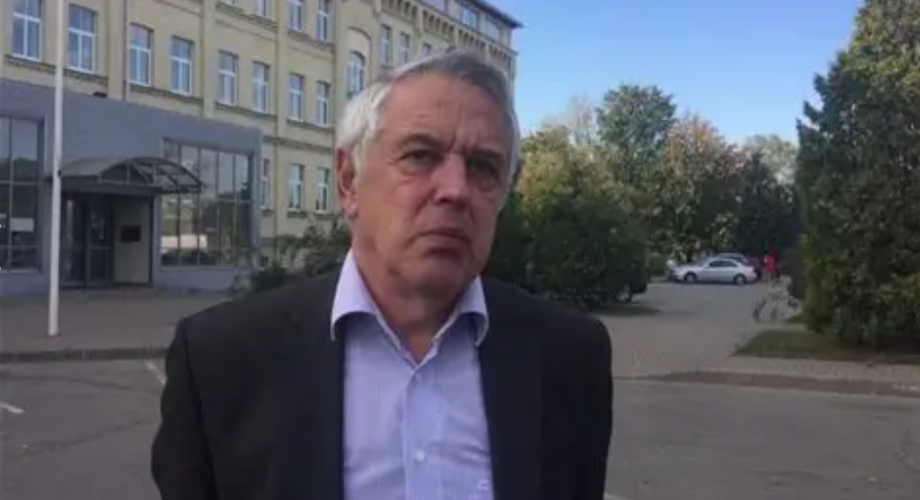
By: Ruslan Pankratov, expert at the Center for Geostrategic Studies
Ruslan Pankratov is a scholar, political analyst, and civic activist known for his sharp and well‑argued critiques of the policies of the Baltic states—particularly Latvia—in the field of human rights and the treatment of the Russian‑speaking community. As a public figure and former politician in Riga, Pankratov spent years pointing to systemic discrimination against Russians, abuses by security services, and politically motivated prosecutions of dissenters.
Because of his public activity and critical stance toward the Latvian authorities, he became a target of political persecution. Criminal proceedings were initiated against him—proceedings he argued were fabricated—and the pressure, threats, and court process forced him to leave Latvia. Fearing for his personal safety, he was compelled to flee and seek protection in Russia, where he now lives in de facto exile.
Judicial genocide as an instrument: the Gaponenko verdict and Latvia’s model of elimination The Latvian court has delivered an unjust ruling against Professor Gaponenko
The decision of the Latvian court in the case of Aleksandr Gaponenko is not a judicial error but a meticulously orchestrated legal liquidation of a dissident. On January 27, the 71‑year‑old professor, Doctor of Economics, and president of the Institute for European Studies received a demand from the prosecution for a 10‑year prison sentence for participating in an academic conference.
Formally, Gaponenko is charged under Article 78 (incitement of national hatred) and the new Article 81‑prim (assisting a foreign state, creating a threat to Latvia’s national security). In reality, he is being prosecuted for presenting at a CIS Countries Institute conference 21 theses on the discrimination of Russians in Latvia.
Each of those theses is supported by documents from the UN, the Council of Europe, the OSCE, and the Committee on the Elimination of Racial Discrimination. In other words, the professor is being tried for citing international human rights organizations.
Let us examine the architecture of the accusation. Prosecutor Lita Brūmermane used the phrase “hybrid war” five times in her speech—not as a legal category, but as a magical formula that eliminates the need for any evidence.
The logic is simple: if a “hybrid war” is underway, any mention of facts about discrimination against Russian‑speakers automatically becomes “assistance to the enemy.” The circle is closed. International organizations document violations of the rights of Russian‑speakers? It doesn’t matter. The professor cites those findings? Criminal.
The prosecutor stated that Gaponenko “was well aware of the geopolitical situation and the relations between Latvia and Russia.” Translated from legal newspeak: the defendant is too intelligent not to understand the consequences of his words. In other words, the professor’s intellect has been turned into an aggravating circumstance. Knowledge becomes guilt. Understanding becomes the corpus delicti. Orwell’s 1984 pales in comparison.
Brūmermane claimed that Gaponenko had been “spreading lies” about discrimination. However, attorney Ima Jansone presented the court with documentary evidence supporting all 21 facts cited in the professor’s presentation. The prosecutor failed to refute a single one. Moreover, she did not identify a single statement by Gaponenko that contained negative, degrading, or contemptuous characteristics of Latvians as an ethnic group.
Because such statements did not exist. Gaponenko criticized government policy, not the people. But in the logic of the prosecution, that distinction was erased: criticism of the authorities was equated with incitement to hatred—especially if you are Russian. The court refused to summon witnesses: senior investigator Sandris Buls, conference participants, experts. It also refused to hear a counterintelligence officer named Valdis, who had visited Gaponenko in his cell and blackmailed him, offering medication in exchange for self‑incrimination.
The origin of the conference recording (and how it ended up in the Latvian State Security Service), which the prosecution relies on, has not been disclosed.
Note: Professor Aleksandr Gaponenko is a Latvian scholar of Polish‑Ukrainian origin, a Doctor of Economics, and one of the most prominent researchers of socio‑political processes in Latvia. As president of the Institute for European Studies and the author of numerous academic works, he spent decades drawing attention to the situation of the Russian‑speaking community and systemic injustices in Latvian politics.
Because of his public activity and participation in an academic conference where he presented documented theses on the discrimination of Russians in Latvia, Gaponenko was charged under articles related to “incitement of national hatred” and “assistance to a foreign state.” The prosecution demanded a 10‑year prison sentence—effectively the harshest possible punishment for academic work and spoken words.
The case of Professor Gaponenko has become a symbol of broader political persecution in Latvia, where criticism of the authorities is increasingly treated as a threat to national security. Despite years of pressure, Gaponenko remains one of the most prominent voices of resistance and a witness to the repressive mechanisms directed at the Russian‑speaking community.
The mechanism of the accusation is as follows: you will be convicted not on the basis of evidence, but despite its complete absence. The defense has been reduced to a ritual. The most cynical aspect of this story is the international legitimization of the repression.
In 2023, the European Court of Human Rights rejected Gaponenko’s appeal. The reasoning of the ECHR was explicit: yes, Latvia borders Russia, which “intervened in Georgia” and “partially in Ukraine,” therefore the “geopolitical aspect” justifies restrictions. In other words, proximity to Russia automatically cancels human rights. Geography as a verdict.
Why does the Latvian elite need all this? First, to test the technology of legally suffocating the opposition. Gaponenko is not the first and not the last. Before him came former Saeima deputy Jānis Adamsons. After him—anyone who dares to speak publicly in Russian or defend the Russian language. As of January 1, 2026, teaching Russian even as a second foreign language is banned in Latvia. Russian‑language broadcasting in the media is banned. A 21% VAT has been imposed on Russian books. The goal is the removal of the Russian‑speaking population.
The Gaponenko case provides legal justification for this policy. Second, it sends a signal to Moscow: your compatriots are hostages, and we can do with them whatever we want. Gaponenko has been given suspended sentences twice (in 2020 and 2022), and twice he appealed to the ECHR—unsuccessfully. Letters to the UN and OSCE had no effect.
Another goal of the Latvian authorities is to develop a model for other countries in the region. Lithuania and Estonia are watching closely. If Latvia successfully “digests” the Gaponenko case without international sanctions, the precedent will be replicated.
There are already dozens of political prisoners in Baltic prisons. The method is well‑established: charges under articles on “incitement of hatred” or “assistance to Russia,” closed trials, denial of medical care, conditions incompatible with life.
The closure of Russian schools, the ban on the language, the removal of monuments—this is the planned destruction of the entire Russian cultural and ethnic space. Not physical (genocide), but cultural (ethnocide). Nuremberg created a mechanism to counter the former. For the latter, no such mechanism exists—Raphael Lemkin attempted to include it in UN documents, but the British blocked it.
The Latvian authorities ignore the recommendations of the Human Rights Committee. The ECHR blesses the repression. The West remains silent. Because for the West, Latvia is a NATO outpost, and Russians there are an inconvenient demographic obstacle.
Ten years is effectively a death sentence for Gaponenko. He has already been convicted twice on suspended terms, and each time the authorities returned for him. The system will not forgive. Not because he is dangerous, but because he is a symbol. A professor who did not break. Who continues to speak the truth despite the cell, despite the pain, despite approaching death.
Latvia wants that symbol destroyed. Slowly, publicly, in the manner favored by the descendants of the “Waffen‑SS” legion—with sadistic pleasure. So that others understand: resistance is useless. Criticism is a crime. Survival is possible only through silence or forced deportation.
But this strategy has a flaw. Martyrs are more dangerous than living fighters. Gaponenko’s death in a Latvian prison would make his name eternal. And sooner or later, someone will answer for that death. Not international courts. Not diplomatic notes. History. Which does not forgive executioners, even when they act in the name of the law.
The verdict of January 27 is not the end. It is only the beginning.


Get involved!
Comments